 Sakshi Singh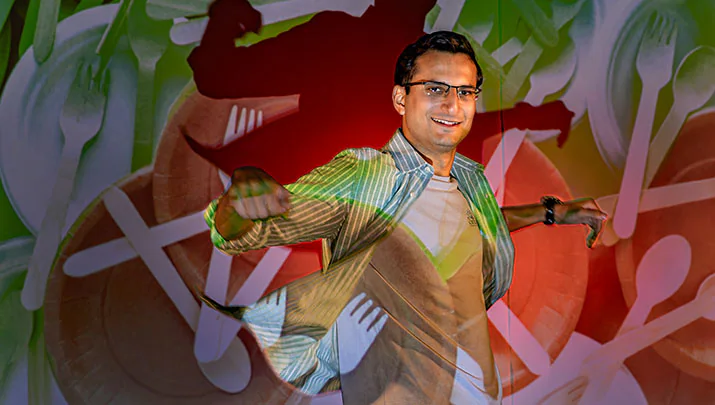
Plastic waste is visible in landfills, on roads and in water bodies. Rishabh Suri chose to address this problem by changing what people use every day. Plates, bowls and food containers.
In 2020, Suri co-founded qudrat with his brother Rohan Suri. The company makes tableware from agricultural waste such as rice husk and rice straw. The goal is simple. Replace single-use plastic with materials that return safely to the soil.
In less than two years of commercial operations, qudrat has replaced close to one lakh kilograms of plastic waste.
Choosing the Harder Path
Suri chose entrepreneurship over joining the family business. He wanted to work on waste reduction. He explored several areas, from e-waste to solid waste, before narrowing his focus to agri waste.
Agricultural waste was often burned or dumped. Suri saw value in it.
He wanted to make products that could serve daily needs and still stay safe for the environment.
Building the Product
qudrat was incorporated in 2020. The founders partnered with the Council of Scientific and Industrial Research in Thiruvananthapuram to work on material science and product testing.
It took nearly two years of trials to finalise the right mix of raw materials and design. Production began around November 2022.
The tableware is made from rice husk and rice straw. According to the founders, the products are sturdy, microwave-safe and freezer-safe. They contain no adhesives, coatings or laminates.
This matters for two reasons. Animals that consume waste are not harmed. When discarded, the products decompose in soil within 30 days.
Early Sales and Growth
qudrat started with pilot sales of ₹1.5 lakh. In FY24, the company reported sales of ₹51 lakh.
The firm remains bootstrapped. Suri says his family has invested around ₹2 crore. The company has also received close to ₹1 crore through government grants and support programmes.
Apart from rice-based tableware, qudrat also sells takeaway packaging made from sugarcane bagasse, rice flour and tapioca starch. Manufacturing for these products is outsourced to partner facilities.
Most revenue comes from B2B clients.
Clients and Markets
qudrat supplies to cafes, hotels and institutions. Its clients include Chaayos, The Leela and the Government of Meghalaya.
The company operates a manufacturing plant in Thiruvananthapuram. Its products are sold not only in India but also in Nepal, the US, the UK, Canada, Mexico, France, Luxembourg and Tanzania.
Support From the Ecosystem
qudrat received a ₹25 lakh grant from Indian Agricultural Research Institute through its incubation unit. The grant was structured in milestone-based tranches. The company has already received the second tranche.
Mentors working with the firm say qudrat has strong export potential due to rising global demand for plastic-free alternatives.
Measuring Impact Beyond Revenue
For Suri, numbers go beyond sales.
In the past 21 months, qudrat has replaced over five million plastic disposables. This translates to nearly one lakh kilograms of plastic removed from use.
The impact also includes reduced crop waste burning and lower carbon emissions compared to plastic manufacturing.
Suri says each product replaces a plastic item that would otherwise remain in the environment for decades.
The Road Ahead
qudrat plans to grow revenue four times each year. The target is ₹100 crore in annual revenue by 2027–28.
The larger goal is scale of impact. Suri wants qudrat to replace at least one billion plastic items within five years.
He believes the solution lies in materials that work for people and the planet.
For qudrat, agricultural waste is not a problem. It is the starting point.
FAQs
Q1. Who is Rishabh Suri?
Rishabh Suri is the co-founder and CEO of qudrat, a social enterprise making tableware from agricultural waste.
Q2. What does qudrat make its products from?
qudrat uses rice husk, rice straw, sugarcane bagasse, rice flour and tapioca starch.
Q3. Are qudrat products biodegradable?
Yes. The products decompose in soil within about 30 days and contain no adhesives or coatings.
Q4. How much plastic has qudrat replaced so far?
The company has replaced close to one lakh kilograms of plastic waste through its products.

 Yash Sharma