 Sakshi Singh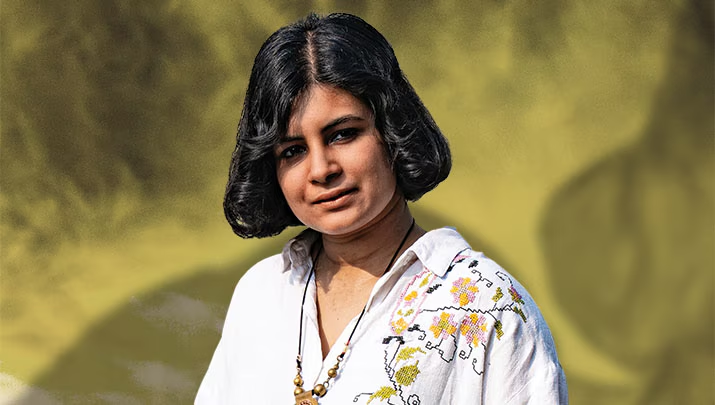
Who is Moumita Basak? Moumita Basak is a contemporary Indian artist known for her work with Kantha stitch, textiles, and recycled cloth. She uses everyday materials like old fabric, tea, and coffee to create artworks that focus on memory, labour, and daily life. In recent months, her name has gained wider attention after she was selected for Forbes India 30 Under 30, Class of 2026, placing her among the country’s most promising young cultural voices.
Moumita Basak was born in 1996 in Srirampur, a village in the Burdwan district of West Bengal. She is 29 years old. Her background in a rural part of Bengal plays a strong role in her art, which stays close to lived experience, domestic spaces, and traditional craft practices.
A Practice Rooted in Kantha Stitch
Kantha stitch is a long-standing textile tradition from Bengal. People have used it for generations in quilts, bedcovers, and daily household cloth. Moumita Basak places this stitch at the centre of her work. She treats it not as decoration, but as a record of time, touch, and labour.
Her artworks often use worn fabric and waste cloth. She stains these materials with tea and coffee instead of paint. These marks stay uneven and raw. They reflect daily habits and slow routines. The surface of each work shows use, repair, and care.
Her approach stays simple and direct. She does not try to hide the stitch or the cloth. Each thread remains visible. Each mark has weight. This clarity has helped her work connect with both local and international audiences.
Studio Work and Community Projects
Moumita Basak works in two ways. Her studio practice draws from her own life, memories, and conversations. These works often feel quiet and personal. They reflect home spaces, domestic labour, and time spent with family.
Her community-based practice involves shared making. She works with groups and participants to build artworks from common stories. These projects focus on listening and exchange. They also show how craft can carry many voices, not just one.
This balance between personal and shared experience has become a key part of her identity as an artist.
Education and Early Recognition
After finishing school, Moumita Basak joined the Government College of Art & Craft, Kolkata, one of India’s oldest art institutions. During her studies, she took part in annual college exhibitions. Faculty members recognised her consistency and skill early on.
She received the Shilpacharya Zainul Abedin Scholarship for several academic years. She later completed her Master of Fine Arts (MFA) in Painting in 2022. During her MFA, she also received the Ajay Bankim Memorial Scholarship.
These awards supported her work and gave her time to develop her textile-based practice in depth.
Exhibitions Across India
Moumita Basak began exhibiting her work while still a student. In 2019, she showed her work at the KCC Art Fair (Emami) and St-Kurge: The Creation at ICCR, Kolkata. That same year, she joined several workshops, including the River Festival Workshop at Prinsep Ghat and the Rajya Charukala Prasad Painting Workshop.
In 2021, her work reached wider national platforms. She participated in the Kochi Student Biennale, a major space for young artists in India. She also showed her work at the Birla Academy of Art and Culture Annual Exhibition and the Bombay Art Society Annual Exhibition.
She also took part in the exhibition ‘1971: Retrospective’, which placed young artists in dialogue with history and memory.
Residencies and Recent Shows
Residency programs have played a steady role in shaping her practice. Moumita Basak took part in the Emami Art Residency Program in Kolkata and the Khoj Peers Residency Program in Delhi. These residencies gave her space to experiment with material and process.
In recent years, her work has appeared in group exhibitions such as ‘World Within World Without’ at Bikaner House, New Delhi, and the Ravi Jain Memorial Foundation Annual Awards Show at Dhoomimal Gallery, Delhi.
Her works have also been shown outside India, including exhibitions in London, Spain, and Poland. These shows introduced her Kantha-based practice to new audiences.
Forbes India 30 Under 30 Recognition
The selection of Moumita Basak for Forbes India 30 Under 30 Class of 2026 marks a key point in her career. The list highlights young professionals across fields who show long-term impact. For Basak, the recognition reflects her role in bringing textile traditions into contemporary art spaces.
Art observers note that her work fits current global interest in sustainability, reuse, and craft-based knowledge. Her practice does not rely on scale or spectacle. It relies on care, time, and skill.
Why Moumita Basak’s Work Matters
Moumita Basak’s art stands at the meeting point of tradition and present life. She does not treat Kantha as something from the past. She treats it as a living method that can still speak today.
By using waste cloth and simple stains, she also raises questions about value and reuse. Her work stays grounded and clear. It avoids excess. This clarity has helped her gain steady recognition without noise.
As Indian contemporary art continues to grow, artists like Moumita Basak show how local practices can hold global meaning.
Most Searched FAQs About Moumita Basak
Q1. Who is Moumita Basak?
Moumita Basak is an Indian contemporary artist known for working with Kantha stitch, textiles, waste cloth, and tea and coffee stains. She was selected for Forbes India 30 Under 30, Class of 2026.
Q2. What is Moumita Basak’s age?
She is 29 years old. She was born in 1996.
Q3. Where is Moumita Basak from?
She is from Srirampur village in the Burdwan district of West Bengal, India.
Q4. What kind of art does Moumita Basak make?
She creates textile-based artworks using Kantha stitch, recycled fabric, and natural stains, focusing on memory, daily life, and shared experience.
Q5. Has Moumita Basak exhibited internationally?
Yes. Her work has been exhibited in India as well as in London, Spain, and Poland.
Q6. Why is Moumita Basak in the news?
She is in the news for being named to Forbes India 30 Under 30, Class of 2026.