 Sakshi Singh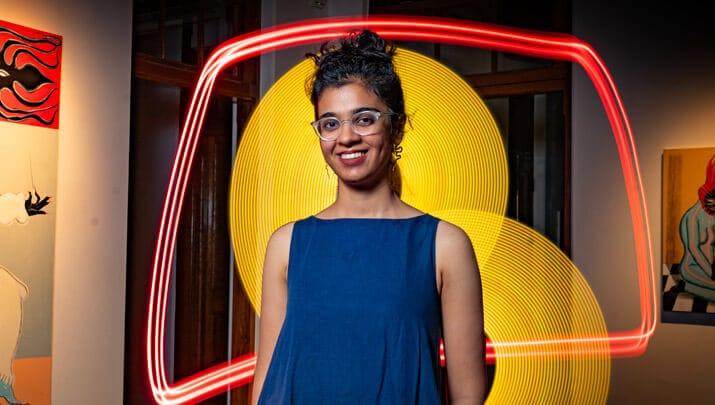
Rithika Pandey, a 24-year-old contemporary artist based in Mumbai, is gaining steady recognition for work that questions how humans relate to the world around them. Through painting, Rithika Pandey explores links between people, plants, animals, land, and unseen forces. Her art moves away from ideas of collapse and instead looks at coexistence and continuity.
Rithika Pandey’s practice came into wider focus after her solo exhibition at the Grosvenor Gallery in London in 2022. Since then, her work has drawn interest from collectors and institutions that follow emerging voices in contemporary art.
A childhood shaped by movement
Rithika Pandey was born in Varanasi but did not grow up in one place. Her early years were spent across Nigeria, Ghana, and Kenya. Living in different countries shaped how she viewed culture, land, and daily life.
This early movement exposed her to varied landscapes and rhythms. These experiences later became part of her visual language. Many of her works reflect a sense of shared space between humans and their surroundings rather than separation.
When she returned to India, Mumbai became her base. The city’s pace and contrasts added another layer to her understanding of space and survival.
Formal training and early direction
Pandey studied Contemporary Art Practices at Srishti Manipal Institute of Art, Design and Technology. During this time, she developed a strong foundation in painting while also engaging with theory and research.
Painting remained her main medium. It came naturally to her and served as her primary way to process ideas. Over time, her focus shifted from individual images to larger visual systems.
After completing her studies, Pandey chose not to move straight into full-time exhibitions. Instead, she took time off to travel and work through artist residencies.
A pause that reshaped her work
One key period came when Pandey spent time in a small town in Wales in the United Kingdom. The slower pace allowed her to work without pressure. She used this time to reflect on direction and intent.
Several works created during this period became central to her later practice. The experience helped her move beyond instinct and towards structure.
This phase marked the beginning of what she now describes as world-building through art.
Art that looks beyond people
Rithika Pandey’s work does not focus only on human stories. She places people within larger systems that include land, animals, plants, and forces that cannot always be seen.
Her paintings draw from mythology and science fiction. These references allow her to imagine spaces where life continues after loss or disruption. Trauma does not become the end point.
She refers to this shared space as the “more-than-human” world. In her view, ignoring these connections limits how societies respond to crisis.
This thinking became stronger during the global pandemic.
Reading and reflection during lockdown
During Covid-related lockdowns in the UK, Pandey spent time reading. Writers such as Ursula K. Le Guin and Donna J. Haraway influenced how she thought about non-human agency and shared survival.
These ideas found form in her work. Her paintings began to show equal weight between human figures and natural elements.
Later, while travelling through remote areas of Himachal Pradesh, she spent time close to forests and mountain regions. This deepened her sense of how land exists beyond human control.
The result was a new body of work shaped by observation rather than urgency.
Recognition at Grosvenor Gallery
In May 2022, Rithika Pandey held a solo exhibition at Grosvenor Gallery in London. The show marked a major step in her career.
The exhibition drew attention from private collectors and a small number of institutions. Visitors engaged closely with the themes and imagery in the work.
Charles Moore, director of the gallery, noted that viewers responded to the personal and reflective nature of her paintings. He described her as a strong emerging voice.
The exhibition helped place Pandey within a wider international context.
Current work and evolving formats
Now based in Mumbai, Pandey continues to focus on painting. She sees it as the base of her practice rather than a limit.
She is interested in expanding her visual worlds into other formats. These may include film, moving images, and immersive installations. The aim remains to create spaces where viewers can pause and reflect.
Her recent work continues to explore balance rather than fear. It asks how people might learn to live with the world rather than above it.
A quiet place in contemporary art
Rithika Pandey’s work aligns with a broader shift in contemporary art. Many artists now question human-centred narratives, especially in the face of climate stress and environmental loss.
What sets Pandey apart is her refusal to rely on alarm. Her work does not instruct or warn. It presents alternatives and invites thought.
Art observers note that this approach resonates with younger audiences who seek depth without spectacle.
Looking ahead
At 24, Pandey remains at an early stage of her career. She continues to work at a steady pace and avoids rushing into visibility.
Future plans include further residencies and exhibitions, both in India and abroad. She remains focused on developing her ideas across mediums while keeping painting at the core.
As discussions around ecology and coexistence grow, her work is likely to remain relevant.
For now, Rithika Pandey continues to build worlds that place humans within, not above, the systems that sustain life.
FAQs
Q1. Who is Rithika Pandey?
Rithika Pandey is an Indian contemporary artist whose work explores human and non-human relationships through painting.
Q2. What is Rithika Pandey’s age?
Rithika Pandey is 24 years old.
Q3. Where has Rithika Pandey exhibited her work?
She held a solo exhibition at Grosvenor Gallery in London in 2022 and has shown work in India and abroad.
Q4. What themes does Rithika Pandey explore in her art?
Her work focuses on ecology, coexistence, non-human agency, mythology, and imagined worlds.

 Yash Sharma