 Sakshi Singh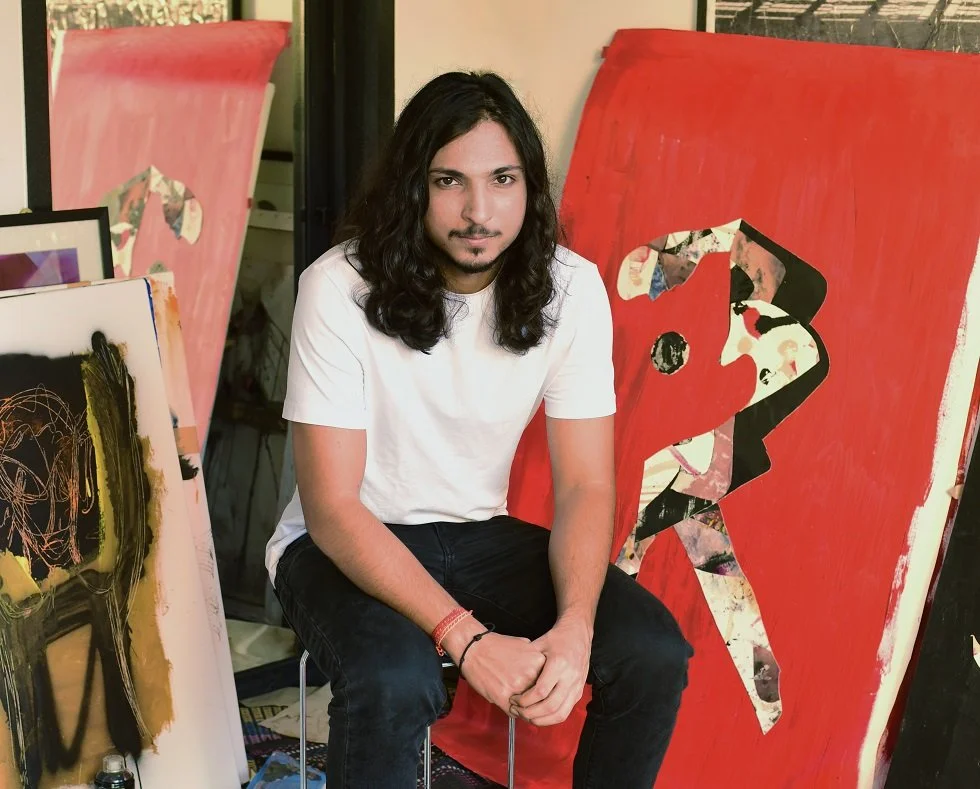
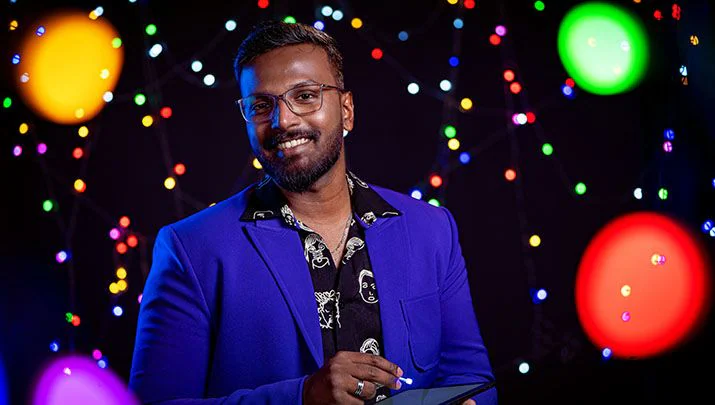
Viraj Khanna, a 28-year-old Indian artist, did not plan a career in art. His entry into the art world began during the Covid-19 lockdown, at a time when most creative industries had come to a halt. What started as a practical step to keep social media pages active for his family’s fashion business has now grown into a full-time art practice with exhibitions in India and abroad.
Khanna is the son of noted fashion designer Anamika Khanna. He studied business administration at the University of Southern California in Los Angeles and returned to India to work with his family’s fashion label. His role focused on marketing, planning, and brand management. Art was not part of his career plan.
That changed in 2020.
When lockdowns shut down shoots, campaigns, and store activity, Khanna looked for ways to keep the brand’s Instagram account active. With limited resources and no production access, he turned to old fashion magazines at home. He began cutting images and assembling collages. The exercise had no artistic goal. It was a response to a work problem.
Over a few weeks, Khanna cut through nearly 400 magazines. He created figures, faces, and abstract forms. He posted them online without expectation. For the first time, he worked without a brief, client, or outcome in mind. The process felt open and direct.
The work caught attention beyond social media.
Somak Mitra, director of Gallery Art Exposure, noticed the collages online and reached out. Mitra saw potential in the lack of structure. He suggested that Khanna consider a gallery show. At the time, Khanna had no experience with exhibitions or fine art spaces.
He accepted the challenge.
Within six months, Khanna prepared his first solo exhibition at The Loft in Kolkata. He translated his collages into sculptures and paintings. Flat paper figures became three-dimensional forms. The exhibition opened in 2021. All the works sold before the public opening, an outcome that surprised both the artist and the gallery.
The response encouraged him to continue.
In 2022, Khanna held exhibitions in Mumbai and Delhi. Each show marked a shift in material and form. He moved away from fibreglass and began working with textiles. Thread, fabric, and embroidery replaced paper and resin. The work retained abstract human forms but focused more on surface and texture.
Mitra says Khanna’s strength lies in his openness. He does not repeat one method. He allows his work to change with each phase. That approach, Mitra notes, stands out in a space where artists often rely on fixed styles.
Khanna’s move toward textiles links back to his upbringing. He grew up around fabric, craft, and garment construction. For a long time, he avoided textiles in his art to separate his identity from the fashion label. Over time, that separation felt forced. He returned to fabric as an artistic medium, not a commercial one.
In 2023, Khanna took part in a two-month exhibition titled Sutr Santati at the National Gallery of Modern Art in Mumbai. The show focused on textile-based practices and was curated by Lavina Baldota. It marked Khanna’s first museum appearance and placed his work alongside established names in textile art.
His work has also gained international exposure. In early 2024, Khanna joined a multi-artist exhibition in Los Angeles. The show introduced his practice to a new audience and tested how his work read outside the Indian context. According to people familiar with the exhibition, his textile pieces drew interest for their balance between form and restraint.
As of 2025, Khanna has taken another step toward formalising his practice. He has enrolled in a Master of Fine Arts programme at the School of the Art Institute of Chicago. The move signals a long-term commitment to art beyond early success.
Despite quick recognition, Khanna keeps his approach measured. He does not frame his work around themes or statements. He begins with material and process. The final form emerges from that engagement. This method reflects how his practice began during the lockdown, without pressure or planning.
Art observers see his journey as part of a wider post-pandemic shift. Many people explored creative paths during lockdowns. Few continued with discipline and growth. Khanna’s case stands out because his practice developed over time and moved into public and institutional spaces.
Recent updates suggest that Khanna is working on new textile-based installations while continuing his studies in the US. Discussions are underway for future group shows in India, though details remain private. He continues to divide his time between India and the US.
For now, Viraj Khanna occupies a space between fashion, craft, and fine art. He does not rush to define it. What began as a workaround during a crisis has become a steady practice shaped by material, process, and change.
FAQs
Q1. Who is Viraj Khanna?
Viraj Khanna is an Indian contemporary artist known for collages, sculptures, and textile-based artworks. He began his art practice during the Covid-19 pandemic.
Q2. What is Viraj Khanna’s age?
Viraj Khanna is 28 years old.
Q3. Is Viraj Khanna related to Anamika Khanna?
Yes. Viraj Khanna is the son of fashion designer Anamika Khanna.
Q4. Where has Viraj Khanna exhibited his artwork?
He has exhibited in Kolkata, Mumbai, Delhi, Los Angeles, and at the National Gallery of Modern Art in Mumbai.