 Sakshi Singh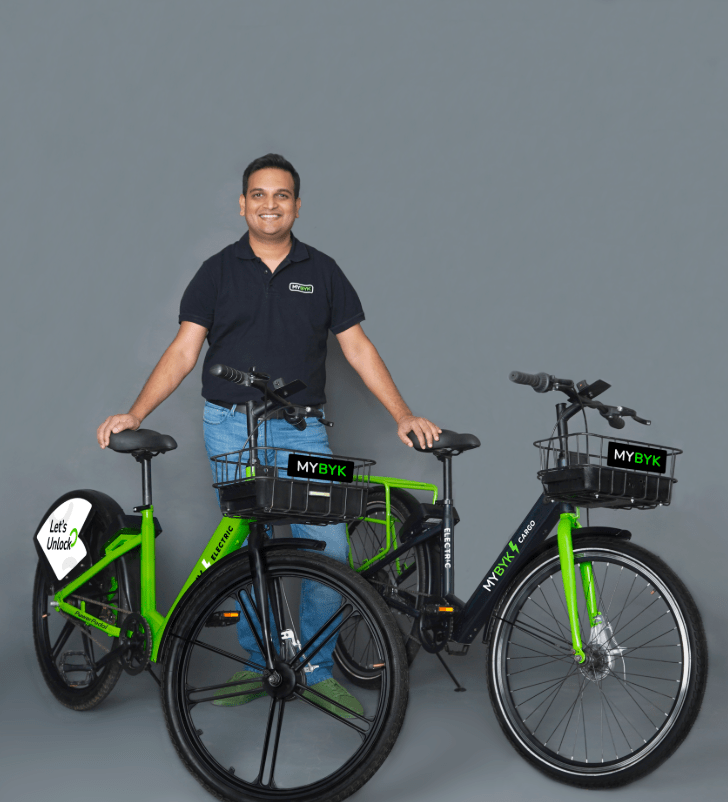
MYBYK entered Shark Tank India with a business designed around a simple urban mobility problem: how to make cycling and public transport more convenient for everyday commuters.
Founded by Arjit Soni, MYBYK is an Indian public bicycle-sharing platform that aims to improve first- and last-mile connectivity. Instead of positioning bicycles simply as an alternative to cars or motorcycles, the company has focused on connecting commuters with existing public transport systems.
Arjit Soni, a Chartered Accountant by qualification and an environmentalist by interest, founded MYBYK after identifying the challenges faced by people who depend on public transportation for daily commuting.
The company began in Ahmedabad and later expanded to cities including Mumbai, Indore, Kochi, Nagpur and Udaipur.
MYBYK Shark Tank India Pitch
Arjit Soni appeared on Shark Tank India in March 2023 to present MYBYK to the show’s investors.
The company’s pitch was:
- Investment sought: ₹2 crore
- Equity offered: 1%
- Asking valuation: ₹200 crore
- Final investment: No deal
Although MYBYK did not receive investment from the sharks, the appearance gave the company national television exposure and brought wider attention to its approach to urban mobility.
Soni later discussed his Shark Tank experience and explained that he wished more of the conversation had focused on the larger problem MYBYK was attempting to solve.
What Is MYBYK?
MYBYK is a public bicycle-sharing service designed to make cycling more accessible and convenient.
Its core proposition is linked to first- and last-mile connectivity.
For many public-transport users, the journey does not begin or end at a railway station or bus stop. Commuters still need to travel the distance between their home and the transport hub.
MYBYK attempts to solve that gap by making bicycles available for short-distance travel.
The model can therefore complement public transport rather than compete directly with it.
The First- and Last-Mile Problem
Urban transportation often faces a connectivity gap.
A commuter may live several kilometres from a railway station or metro stop. Walking may take too long, while taking a cab or auto-rickshaw every day can increase commuting costs.
Private vehicles can solve the problem but contribute to congestion, fuel consumption and emissions.
MYBYK’s approach is to provide bicycles for that connecting journey.
The broader idea is:
Home → Bicycle → Public Transport → Bicycle → Destination
According to Soni, improving this connection can make public transport more convenient and encourage more people to use it.
From Ahmedabad to Multiple Indian Cities
MYBYK began operations in Ahmedabad.
The company subsequently expanded into other Indian cities, including:
- Mumbai
- Indore
- Kochi
- Nagpur
- Udaipur
The expansion reflected the company’s attempt to build a scalable bicycle-sharing network rather than remain limited to one market.
The company also planned to introduce electric bicycle rentals, beginning in Ahmedabad before expanding the service to other cities.
Arjit Soni’s Background
Arjit Soni is a Chartered Accountant and entrepreneur.
His professional background is different from the traditional technology-startup founder profile. His interest in environmental sustainability and urban transportation played an important role in the development of MYBYK.
Soni has described MYBYK as a business built around a social and environmental objective.
However, he deliberately chose a for-profit structure rather than creating an NGO.
His reasoning was that financial sustainability could help the company pursue its social objective at greater scale.
Why MYBYK Was Created
The idea behind MYBYK developed from a broader concern about urban mobility.
Soni has argued that adding more roads and flyovers does not necessarily solve the fundamental transportation problems faced by growing cities.
He believes cities need to encourage:
- Walking
- Cycling
- Public transportation
- Reduced dependence on private vehicles
From this perspective, MYBYK is not simply a bicycle-rental company.
Its larger proposition is to make sustainable transportation easier to use.
The Shark Tank Experience
Soni described his Shark Tank appearance as a memorable experience.
The process involved auditions, preparation, rehearsals and several rounds before the final pitch.
However, he also acknowledged that the television episode represented only a portion of the actual discussion.
According to Soni, a typical pitch can involve substantially more conversation than what eventually appears in the broadcast episode.
He felt that some of the discussion surrounding MYBYK’s environmental and social impact did not receive as much screen time as he expected.
Why Soni Wanted to Focus on the “Why”
One of Soni’s biggest takeaways from the experience was the importance of explaining why the company exists.
He believed the pitch concentrated too heavily on the business solution and financial aspects.
His preferred narrative was broader:
Why should people use public transport?
Why should cities encourage cycling?
Why should commuters replace short private-vehicle journeys?
And how can bicycles make public transport more accessible?
For Soni, these questions represent the foundation of MYBYK’s business.
MYBYK as a Social Enterprise
Soni has described himself as someone for whom purpose comes first, while also recognising that financial sustainability is necessary.
This creates an interesting balance in MYBYK’s business model.
The company operates commercially but attempts to address issues including:
- Urban congestion
- Air pollution
- First- and last-mile connectivity
- Dependence on private vehicles
- Public transport accessibility
The objective is to make sustainable mobility commercially viable rather than depend entirely on donations or government funding.
Investment Requirements and Scaling Plans
Soni said MYBYK was seeking equity investment primarily for technology and marketing.
According to him, the company had already developed an operational model that could be scaled.
The next stage required investment in:
- Technology
- Marketing
- Leadership
- User acquisition
- Customer retention
- Fleet expansion
The company also considered debt financing to increase the number of bicycles in its fleet.
MYBYK’s Electric Bicycle Plans
One of the company’s important expansion areas was electric bicycles.
MYBYK planned to launch e-bike rentals beginning in Ahmedabad and then gradually expand them into other markets.
Electric bicycles can potentially make cycling more practical for longer distances and users who may find conventional bicycles physically demanding.
For a public bicycle-sharing platform, this could also expand the number of journeys for which the service is suitable.
The Ambitious Fleet Target
At the time of the Shark Tank appearance, Soni outlined ambitious growth targets.
The company aimed to reach:
1 lakh bicycles within 18–24 months
and eventually:
1 million bicycles within 48–60 months.
Achieving such numbers would require significant investment in fleet procurement, maintenance, technology, charging infrastructure for e-bikes and city-level operations.
The targets nevertheless demonstrated the scale of Soni’s long-term vision for MYBYK.
What MYBYK Wants From Government
Soni believes government policy can play an important role in encouraging cycling.
He pointed to initiatives promoting cycling and public transportation but argued that implementation at the city level remains inconsistent.
According to his view, Indian cities need more dedicated infrastructure, including:
- Protected bicycle lanes
- Shaded cycling routes
- Better connectivity between cycling networks
- Support for electric bicycles
- Incentives that reduce the cost of bicycles
He believes such measures could make cycling more attractive while allowing businesses such as MYBYK to expand faster.
The Ideal Cycling City
For Soni, the idea extends beyond cycling infrastructure.
He prefers to think about the ideal city rather than simply the ideal cycling city.
His vision is a city where people can walk or cycle for short-distance journeys and use public transport for longer trips.
Such a city would also prioritise safety, cleaner air and greener public spaces.
The ultimate objective is therefore not to put every commuter on a bicycle.
It is to create cities where people have practical alternatives to private vehicles.
Message to People Hesitating to Cycle
Soni has encouraged people who are unsure about cycling to start with short journeys.
His suggestion is simple: replace some routine trips, such as travelling to a nearby shop or gym, with a bicycle.
He believes that using a combination of bicycle plus public transport can help commuters experience the practical benefits themselves.
This approach also allows people to gradually overcome concerns around weather, safety and convenience.
Why MYBYK Matters to India’s Mobility Future
India’s cities are expanding rapidly, and transportation remains one of the major challenges accompanying urbanisation.
Public transport can move large numbers of people efficiently, but its usefulness depends partly on how easily passengers can reach stations and stops.
This is where bicycle-sharing can potentially play a role.
MYBYK’s model attempts to connect two forms of mobility that are often treated separately: cycling and public transport.
The company therefore represents a broader shift in how Indian startups are approaching urban transportation.
MYBYK After Shark Tank India
MYBYK did not secure an investment from the sharks during its Shark Tank India appearance.
However, the pitch provided national exposure for the company and its founder.
More importantly, Soni used the platform to communicate a broader argument about Indian cities: transportation solutions should not focus only on building more roads, but also on making sustainable alternatives practical for everyday commuters.
His experience also reinforced his view that MYBYK’s story is fundamentally about the problem it wants to solve, rather than simply the bicycle-sharing product itself.
Conclusion
MYBYK’s Shark Tank India journey is an example of a startup using business to address a wider urban challenge.
Founded by Arjit Soni, the company began in Ahmedabad and expanded its public bicycle-sharing service to multiple Indian cities. Its focus on first- and last-mile connectivity connects cycling with public transport and offers commuters an alternative to short private-vehicle journeys.
MYBYK entered Shark Tank India seeking ₹2 crore for 1% equity, valuing the company at ₹200 crore. The company did not receive an investment from the sharks.
Despite the absence of a deal, the appearance gave MYBYK national visibility and allowed Soni to present his larger vision: cities that prioritise walking, cycling and public transport while reducing dependence on private vehicles.
The company’s long-term success will depend on factors including fleet economics, infrastructure, technology, user adoption and government support. But its central idea remains straightforward better public transport also requires better ways to reach it.
Most Searched FAQs
Q1. What is MYBYK?
MYBYK is an Indian public bicycle-sharing service focused on making cycling convenient and improving first- and last-mile connectivity with public transportation.
Q2. Who founded MYBYK?
MYBYK was founded by Arjit Soni, a Chartered Accountant and entrepreneur with an interest in environmental sustainability and urban mobility.
Q3. What was MYBYK’s Shark Tank India deal?
MYBYK asked for ₹2 crore for 1% equity, implying a ₹200 crore valuation. The company did not receive an investment from the sharks.
Q4. Which cities does MYBYK operate in?
MYBYK began in Ahmedabad and had expanded to cities including Mumbai, Indore, Kochi, Nagpur and Udaipur at the time of its Shark Tank India appearance.
Q5. What problem does MYBYK solve?
MYBYK focuses on the first- and last-mile connectivity gap in public transportation by providing bicycles for journeys between commuters’ homes, workplaces and public transport hubs.
Q6. What are MYBYK’s future plans?
At the time of the Shark Tank appearance, the company planned to expand its fleet, invest in technology and marketing, enter more cities and launch electric bicycle rentals.
Read also: SweeDesi News: SweeDesi Builds Demand for Regional Sweets After Shark Tank India Pitch