 Sakshi Singh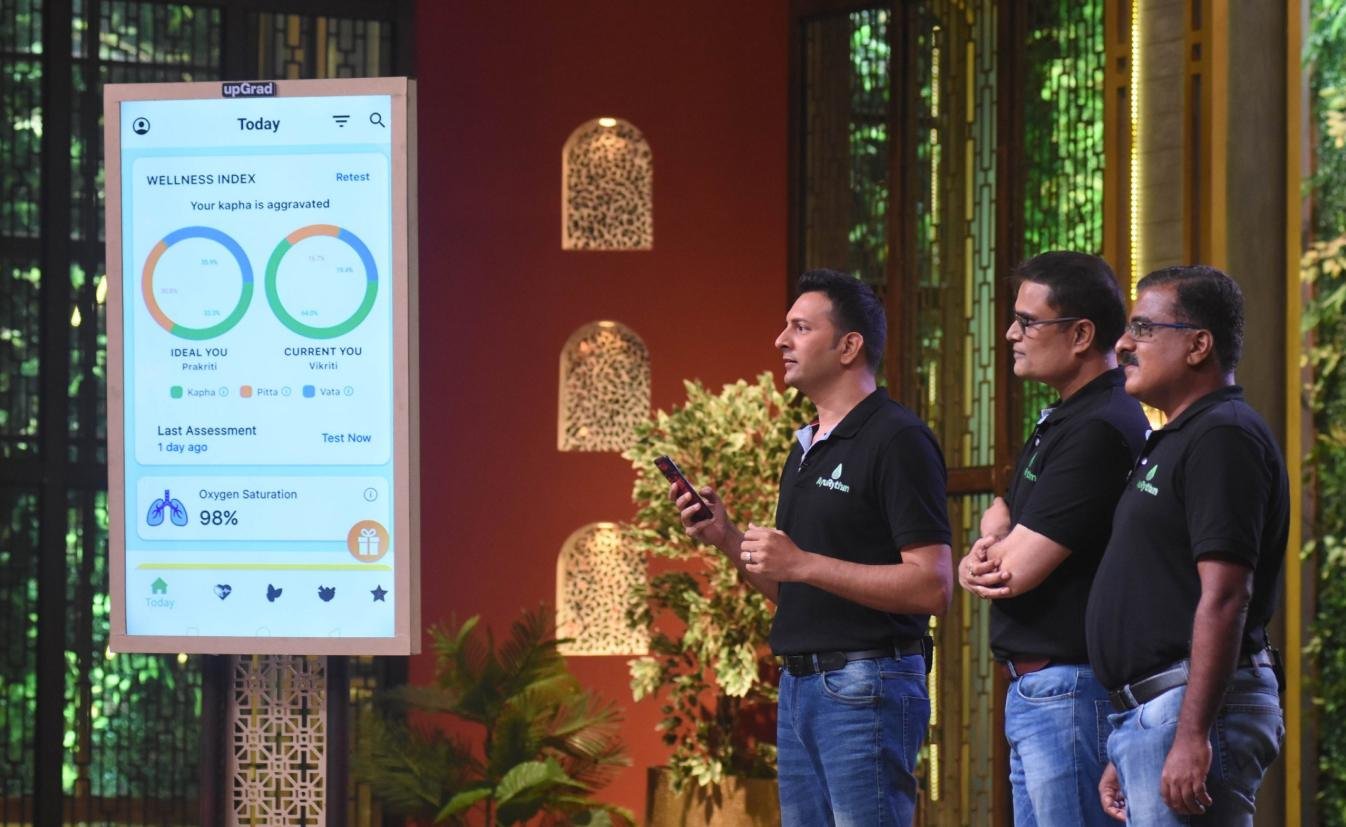
AyuRythm entered Shark Tank India Season 1 with an ambitious idea: use technology to make personalised Ayurvedic wellness easier to access.
The Bengaluru-based startup was founded by Ramanath Padmanabhan, Abhilesh Gupta and Sandeep Acharya. Its platform was designed around Ayurvedic concepts such as Prakriti and Vikriti, while using smartphone-based assessments to generate personalised wellness recommendations.
On Shark Tank India, AyuRythm asked for ₹75 lakh for 2% equity, implying an asking valuation of ₹37.5 crore.
The company ultimately accepted an offer from Aman Gupta for ₹75 lakh for 2.68% equity, implying a valuation of approximately ₹27.99 crore.
AyuRythm’s Original Shark Tank India Ask
The company’s Shark Tank proposal was:
- Investment sought: ₹75 lakh
- Equity offered: 2%
- Asking valuation: ₹37.5 crore
The pitch focused on personalised Ayurvedic wellness rather than conventional fitness tracking.
AyuRythm presented itself as a digital platform that could use a smartphone to collect information and provide recommendations based on Ayurvedic principles.
The Final Deal With Aman Gupta
The pitch eventually resulted in an offer from Aman Gupta, co-founder of boAt.
Gupta initially proposed ₹75 lakh for 5% equity, subject to further validation of the technology.
The founders negotiated the equity down to 2.68%, and Aman Gupta accepted.
The final deal was therefore:
₹75 lakh for 2.68% equity
This gave the company an implied valuation of approximately ₹27.99 crore, considerably below its original ₹37.5 crore asking valuation.
What Is AyuRythm?
AyuRythm describes itself as a digital platform for personalised holistic wellness based on Ayurvedic principles.
Its concept combines traditional Ayurvedic frameworks with smartphone technology.
The platform has been designed around three broad steps:
- Prakriti assessment
- Vikriti or wellness assessment
- Personalised recommendations
The company says users can receive recommendations relating to areas such as yoga, pranayama, food, herbs and other wellness practices.
The platform has also promoted a library containing more than 1,800 home remedies.
How the AyuRythm Assessment Works
One of AyuRythm’s key technology propositions is smartphone-based pulse assessment.
The company has described a 30-second camera-based pulse assessment that uses photoplethysmography principles to analyse signals captured through a smartphone camera.
According to the company’s model, the resulting data is processed to generate a wellness index and connect the findings with Ayurvedic concepts.
However, these assessments should be understood as wellness tools rather than substitutes for medical diagnosis or clinical testing. The company itself told the Shark Tank panel that its platform was intended for lifestyle management, wellness and prevention rather than established diagnostic purposes.
Personalised Wellness Through Ayurveda
A central idea behind AyuRythm is that Ayurveda treats individuals differently rather than applying exactly the same lifestyle recommendations to everyone.
The company uses the concept of Prakriti, which relates to an individual’s constitution, as part of its assessment framework.
Users answer a set of questions to determine their reported body type. The platform then combines this information with subsequent assessments to generate personalised recommendations.
The company says its recommendations can cover:
- Yoga
- Pranayama
- Food
- Herbs
- Spa and wellness activities
- Lifestyle practices
This personalisation is intended to address one of the challenges the founders identified in traditional wellness content: information can be difficult to navigate and may not feel relevant to every individual.
The Story Behind AyuRythm
The company was founded by three professionals who shared an interest in fitness and wellness.
Ramanath Padmanabhan, Abhilesh Gupta and Sandeep Acharya noticed that many people wanted to remain healthy but did not necessarily want to follow calorie-counting or intensive bodybuilding routines.
That observation led them to explore Ayurveda as an alternative framework for lifestyle and wellness.
They saw two challenges.
First, Ayurvedic information was not always presented in an accessible digital format.
Second, Ayurveda’s emphasis on individual differences meant that generic advice could have limited usefulness.
AyuRythm was created as an attempt to bring those concepts into a digital platform.
Who Are the Founders?
Abhilesh Gupta
Abhilesh Gupta is an aeronautical engineer with more than two decades of experience across different industries. His career includes management roles and international business experience.
Ramanath Padmanabhan
Ramanath Padmanabhan has worked across strategy, business and technology. His experience includes entrepreneurship as well as leadership roles involving startups and multinational companies.
Sandeep Acharya
Sandeep Acharya, also known as Data Eagle, is an engineer and MBA with experience in data analytics and business intelligence.
The combination of engineering, business strategy and data expertise helped shape AyuRythm’s technology-focused approach to Ayurveda.
From Prototype to Startup
AyuRythm’s development began before its Shark Tank appearance.
The company says it developed an initial prototype in 2017 and filed patents in India.
Its timeline includes several milestones:
- 2017: Prototype development and patent filings
- 2018: Apple Design Accelerator programme and partnerships
- 2019: Pre-seed investment and additional partnerships
- 2020: Beta app launch and startup programme selections
- 2021: Shark Tank India finalist and additional investment activity
- 2022: Google innovation and accelerator recognition
- 2023: Selection for the Google for Startups accelerator
The company also highlighted partnerships and interactions with organisations across the wellness, technology and government ecosystem.
AyuRythm on Shark Tank India
The Shark Tank pitch brought the company’s technology under intense questioning.
The panel raised concerns around the accuracy and interpretation of the assessment technology.
Some investors also questioned how the company should position itself — whether primarily as a technology company, a consumer wellness platform, or a broader Ayurvedic service.
The founders maintained that their technology and algorithms represented an important part of their competitive advantage.
Aman Gupta ultimately saw potential in the technology and proposed an investment subject to further validation.
That resulted in the ₹75 lakh deal for 2.68% equity.
What Happened After Shark Tank India?
AyuRythm reportedly experienced a sharp increase in attention after its episode aired.
According to post-show reporting, the company crossed 500,000 app downloads after appearing on Shark Tank India. The sudden increase in traffic also reportedly created technical problems for the app, including difficulties with OTP verification.
However, the status of the Shark Tank deal later became less clear.
A 2025 review by Shark Tank India Club reported that its research indicated the agreement with Aman Gupta was never finalised, although the precise reason was not publicly established. The same report said the company had raised another round after the show but appeared to have become inactive by early 2025.
This distinction is important: the televised Shark Tank deal was ₹75 lakh for 2.68% equity, but publicly available post-show reporting suggests the agreement may not have ultimately closed.
Technology and Ayurveda at the Core
AyuRythm’s proposition sits at the intersection of two very different worlds.
Ayurveda provides the traditional framework, while smartphone cameras, data processing and algorithms provide the technology layer.
The company has attempted to make this combination accessible without requiring specialised equipment.
Its broader vision has been to create a digital hub where users can assess their wellness, receive personalised suggestions and access educational content.
Government and Ecosystem Recognition
Before and after its Shark Tank appearance, AyuRythm participated in several technology and innovation programmes.
The company highlighted involvement with government initiatives, startup programmes and international technology accelerators.
It was also selected for the Google for Startups accelerator in 2023 as one of 20 startups selected from more than 1,050 applications, according to the company’s own timeline.
These programmes provided visibility as AyuRythm attempted to scale its technology and explore applications of artificial intelligence and data analytics.
A Digital Approach to Traditional Wellness
AyuRythm’s broader idea reflects a growing trend in India’s startup ecosystem: using technology to package traditional knowledge for modern consumers.
The company did not attempt to replace Ayurveda with technology. Instead, it sought to build a digital interface around Ayurvedic concepts.
Its model focused on making information easier to access while offering users personalised recommendations.
The approach also reflects the growing consumer interest in preventive wellness, fitness, yoga and personalised lifestyle guidance.
The Challenge of Accuracy
Technology-driven wellness platforms face an important challenge: consumers need to understand what an assessment can and cannot establish.
During AyuRythm’s Shark Tank appearance, the investors questioned the reliability of its technology and asked how accurately it could identify Ayurvedic body types and related wellness indicators.
For any health-related technology, validation and transparent communication are critical.
A wellness assessment should not be presented as equivalent to a clinical diagnostic test unless it has been appropriately validated and regulated for that purpose.
This issue became one of the central discussion points around AyuRythm’s Shark Tank pitch.
Current Position
AyuRythm’s Shark Tank appearance remains one of the notable examples of a startup attempting to combine Ayurveda with digital technology.
The company secured a headline deal of ₹75 lakh for 2.68% equity from Aman Gupta, although later reporting questioned whether the agreement was ultimately completed.
Its journey also illustrates the difficulty of scaling a health and wellness technology platform: strong consumer interest must be matched by reliable technology, clear positioning, technical infrastructure and evidence supporting product claims.
Conclusion
AyuRythm entered Shark Tank India with a distinctive proposition: bring personalised Ayurvedic wellness to smartphones.
Founded by Ramanath Padmanabhan, Abhilesh Gupta and Sandeep Acharya, the startup combined Ayurvedic concepts with smartphone-based assessments, personalised recommendations and a large library of wellness information.
Its Shark Tank India pitch resulted in a proposed ₹75 lakh investment for 2.68% equity from Aman Gupta, valuing the company at about ₹27.99 crore.
The company’s subsequent journey, including questions around deal closure and its later operational status, highlights an important lesson for health-tech startups: innovation can attract attention, but long-term success depends on validation, trust, execution and sustainable consumer value.
Most Searched FAQs
Q1. What is AyuRythm?
AyuRythm is a digital wellness platform built around personalised Ayurvedic wellness. It combines Ayurvedic concepts with smartphone-based assessments and recommendations related to areas such as yoga, food, pranayama and herbs.
Q2. What was AyuRythm’s Shark Tank India deal?
AyuRythm accepted a proposed deal of ₹75 lakh for 2.68% equity, implying a valuation of approximately ₹27.99 crore.
Q3. Which shark invested in AyuRythm?
Aman Gupta, co-founder of boAt, made the investment offer on Shark Tank India.
Q4. Who founded AyuRythm?
AyuRythm was founded by Ramanath Padmanabhan, Abhilesh Gupta and Sandeep Acharya.
Q5. What was AyuRythm’s original Shark Tank ask?
The startup originally sought ₹75 lakh for 2% equity, implying an asking valuation of ₹37.5 crore.
Q6. Did Aman Gupta’s AyuRythm deal close?
The televised deal was ₹75 lakh for 2.68% equity. However, later reporting from Shark Tank India Club stated that its research indicated the deal was not ultimately finalised; the exact reason was not publicly established.
Read also: IN A CAN News: IN A CAN Grows Ready-to-Drink Cocktail Business After Shark Tank India Deal