 Sakshi Singh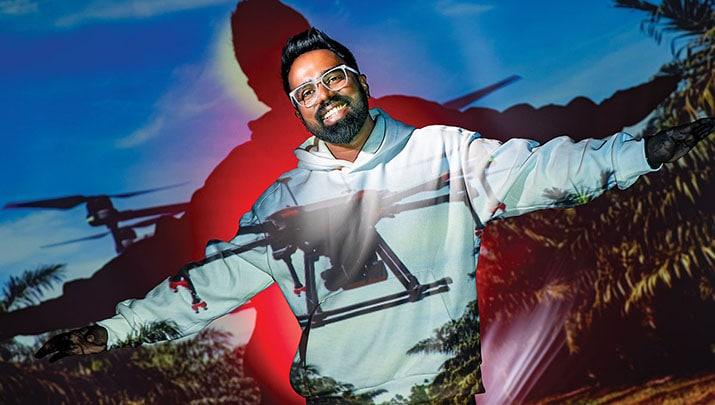
Devan Chandrasekharan agritech innovation is shaping how Indian farmers use technology in daily farm work. At 28, Devan Chandrasekharan leads Fuselage Innovations, a company that builds drone-based tools for farming, disaster response, and land monitoring. His work focuses on one goal: helping farmers grow more crops at lower cost using clear data from the air.
India’s farming sector faces rising costs, climate stress, and labour shortages. Chandrasekharan’s approach uses unmanned aerial vehicles, also called UAVs, to give farmers fast and clear insight into crop health. This method helps farmers act before damage spreads across fields.
A Personal Problem That Led to a Startup
The idea for Fuselage Innovations came from a family crisis. In 2017 and 2018, floods hit Kerala with force. In Alappuzha district, the floods damaged soil quality and reduced crop yield. Chandrasekharan’s mother, Ambika Chandrasekharan, farms in the region. Like many others, she struggled to restore productivity after the water receded.
At that time, Devan Chandrasekharan had finished his degree in aeronautical engineering. He chose not to enter aviation or defence. He instead tested how drones could scan crops and identify plant stress. He focused on plant condition instead of soil tests alone. Early trials showed clear results. The data helped spot damage faster than manual checks.
In 2020, Chandrasekharan and his sister Devika started Fuselage Innovations. The company aimed to give farmers tools they could use without complex systems or long delays.
What Fuselage Innovations Does
Fuselage Innovations builds drone systems that combine hardware and software. The company works with UAVs, sensors, and artificial intelligence. Its main focus is agriculture, but the same tools support disaster response, land surveys, and infrastructure checks.
In farming, drones map fields and capture images across light bands. Software then studies crop patterns. This process helps farmers see pest attacks, nutrient gaps, and water stress early. Farmers can then treat only the affected area. This method saves money and reduces chemical use.
Chandrasekharan says the goal is simple. Give farmers clear data. Let them decide faster.
Two Core Drone Products
Fuselage Innovations has launched two main drone systems.
The first is the FIA QD10. This drone has approval from the Directorate General of Civil Aviation. It handles precision spraying. Farmers use it to apply fertilisers and pesticides only where needed. This limits waste and protects surrounding crops.
The second system is the Nireeksh drone. This drone monitors crops over time. It uses multispectral sensors to track plant health. Farmers receive field maps that show weak areas before damage spreads. This helps plan irrigation, spraying, and harvest cycles.
Both systems target medium and large farms but also support cooperatives and shared farming models.
Growth Without Easy Funding
Building hardware in India brings hurdles. Chandrasekharan faced rejection from investors in the early phase. Many cited risk and weak support for hardware startups. Venture capital interest stayed low.
To move forward, he took a bank loan of ₹7.5 lakh. This funded early builds and field trials. The company focused on working products instead of rapid scale.
This choice brought results. In the last financial year, Fuselage Innovations reported a turnover of ₹5 crore. The company now operates from Maker Village in Kochi, one of India’s largest electronics incubators. The facility gives access to labs, testing space, and mentors.
Impact on Farmers
Farmers who use Fuselage drones report strong results. Crop output has risen by up to 30 percent in several pilot regions. Crop management costs have dropped by as much as 70 percent. These gains come from lower chemical use and fewer labour hours.
The drones also help after natural disasters. Aerial scans show damaged zones in hours instead of days. This speed helps farmers plan recovery and reduces guesswork.
Despite these results, adoption remains uneven. Chandrasekharan notes that many state schemes still rely on older methods. Even certified drones often fail to reach government programs. He sees this as a policy gap rather than a technical one.
Agritech and the Road Ahead
India’s agritech sector is growing. Government drone rules have eased. Demand for precision farming tools is rising. Climate risk adds pressure to improve yield per acre.
Chandrasekharan plans to expand Fuselage Innovations into soil analysis and water use tracking. These areas matter as groundwater levels fall and fertiliser prices rise. The company also plans wider deployment in disaster-prone regions.
His focus remains steady. Build tools that farmers trust. Keep systems simple. Solve problems on the ground.
As agritech gains ground, Devan Chandrasekharan’s work shows how local problems can shape national solutions.
FAQs
Q1. Who is Devan Chandrasekharan?
An Indian agritech entrepreneur and aeronautical engineer. He is the founder and managing director of Fuselage Innovations.
Q2. What does Fuselage Innovations do?
It develops drone-based systems for farming, crop monitoring, disaster assessment, and land mapping using UAVs and AI.
Q3. What are the main drones developed by Fuselage Innovations?
The company has built the DGCA-certified FIA QD10 precision spraying drone and the Nireeksh crop monitoring drone.
Q4. How do Fuselage drones help farmers?
They improve crop yield, cut farm costs, reduce chemical use, and give early warnings of crop stress.


 Arise Times
 Yash Sharma