 Sakshi Singh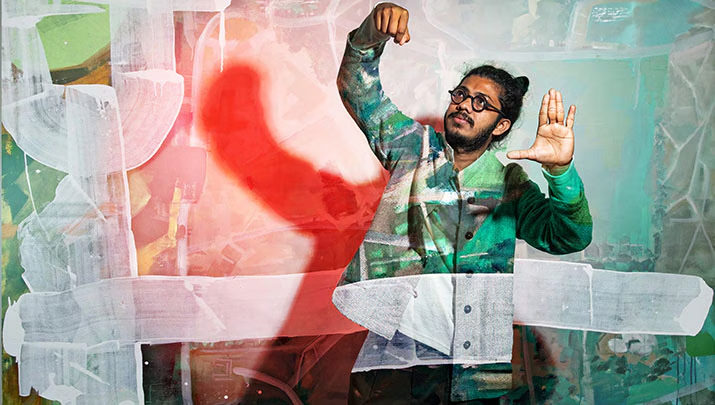
Rabiul Khan artist journey reflects a shift in how young Indian artists engage with place, memory, and power. At 27, Rabiul Khan has built a practice rooted in lived experience and research. His work does not aim to decorate walls. It aims to ask questions. Often uncomfortable ones.
Born in Adampur village in West Bengal’s Birbhum district, Khan grew up in a family involved in coal mining. While Birbhum is widely linked with Santiniketan and cultural heritage, Khan points to another side of the region. He describes it as a space shaped by silent violence, weapons, and fear that exist alongside art and learning.
His father wanted a different future for the family. To secure better education and safety, the family moved to Dubrajpur town. This decision changed Khan’s path.
Early Signs of an Artist
In school, teachers noticed Khan’s drawing skills. They encouraged him to study art near Santiniketan. He trained under local art teachers before enrolling at Kala Bhavan, the fine arts faculty of Visva Bharati University. He completed both his bachelor’s and master’s degrees there.
Kala Bhavan gave him technical grounding. It also gave him questions. Khan felt that while studio practice remained strong, research-led and interdisciplinary work lacked space. This gap stayed with him through his student years, including the Covid-19 lockdown period.
Instead of waiting for institutional change, Khan chose to build his own platform.
Founding the Gabaa Collective
Along with friends from college, Khan co-founded Gabaa, an artist collective based on shared inquiry. The group focuses on site-specific, research-driven work. Their projects often engage with local history, political memory, and everyday life.
Gabaa operates from a space funded by Khan’s father. The space functions as a working studio, discussion room, and learning site. The collective invites young artists to develop issue-based projects. These projects may involve communities or re-read historical narratives tied to specific locations.
Khan says the aim is not to reject painting or sculpture. It is to move beyond fixed formats when the subject demands it.
Art as a Question, Not an Answer
Khan’s practice relies on installations that respond to their setting. He treats each site as a classroom. The work draws people into dialogue. Local residents become part of the process, not just viewers.
He believes society avoids difficult questions. His work tries to reverse that trend.
One of his key projects, Amar Birbhum (My Birbhum), grew from personal research during his master’s degree. Khan traced his ancestry and found links to Afghan communities that had been used for centuries by rulers and governments to enforce violence. These groups served nawabs, colonial powers, and later political systems.
This history shaped how he saw his land. His Birbhum did not match the popular image of calm culture and poetry. The project challenged how history gets framed and who gets left out.
National Attention and Awards
Khan’s work gained national notice in recent years. In 2023, he received the Inlaks Fine Art Award. The following year, he was named a recipient of the Prince Claus Fund Seed Award. These recognitions placed him among a new group of Indian artists whose work blends social research with visual practice.
As part of his Inlaks residency in Mumbai, Khan created Bombay kiska hai? (Who does Bombay belong to?). The project questioned ownership of the city. Rather than speak for communities, Khan created spaces for dialogue.
He worked with women from the Koli fishing community. He also brought together people from different social classes. The meetings focused on the city’s past, labour, and access to space. The artwork existed as a shared experience rather than a fixed object.
How Peers See His Work
Faculty members at Kala Bhavan note Khan’s process-driven approach. Sanchayan Ghosh, associate professor in the department of painting, describes Khan as an artist who moves between private memory and public space. He does not limit material to form. He treats it as memory and evidence.
This approach places Khan within a growing movement in Indian contemporary art that values context over spectacle.
Art, Politics, and the Everyday
Khan avoids slogans. His installations often appear quiet. The politics emerge through interaction. Domestic spaces, streets, and community sites become part of the work. Viewers must spend time to understand what is being asked.
Through Gabaa, Khan continues to develop projects that function as temporary learning sites. These spaces allow exchange between artists and communities. Each project leaves behind conversations rather than monuments.
At a time when art markets often reward speed and visibility, Khan’s work moves at a slower pace. It asks viewers to listen, reflect, and question what they accept as normal.
As Indian contemporary art expands beyond galleries, Rabiul Khan’s practice shows how personal history and public space can meet without losing depth.
FAQs
Q1. Who is Rabiul Khan?
Rabiul Khan is a 27-year-old Indian contemporary artist from West Bengal. He works with installations, research-based art, and community engagement.
Q2. What is Gabaa collective?
Gabaa is an artist collective founded by Rabiul Khan and his peers. It focuses on site-specific, research-led, and community-based art projects.
Q3. What awards has Rabiul Khan received?
He received the Inlaks Fine Art Award in 2023 and the Prince Claus Fund Seed Award in 2024.
Q4. What themes does Rabiul Khan explore in his art?
His work explores history, violence, identity, public space, and the relationship between communities and power.

 Arise Times
 Yash Sharma