 Arise Times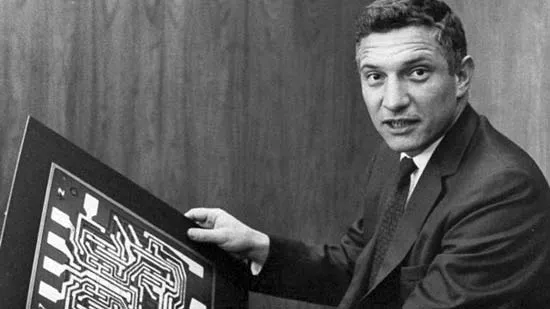
Few innovators have influenced the technology industry as profoundly as Robert Noyce. Best known as the co-founder of Intel Corporation and Fairchild Semiconductor, Noyce played a central role in the invention of the integrated circuit (IC), commonly known as the microchip. His work transformed electronics by making computers smaller, faster, and more affordable, laying the technological foundation for today’s digital economy.
Often referred to as one of the architects of Silicon Valley, Noyce combined scientific expertise, entrepreneurial vision, and collaborative leadership to help shape the global semiconductor industry. His contributions continue to power everything from smartphones and artificial intelligence to medical equipment and space exploration.
Early Life and Academic Foundation
Robert Norton Noyce was born on December 12, 1927, in Burlington, Iowa, United States. From an early age, he displayed a strong interest in science, engineering, and problem-solving, interests that would define his career.
He earned a Bachelor of Arts in Physics from Grinnell College in 1949 before pursuing advanced research at the Massachusetts Institute of Technology (MIT).
In 1953, Noyce completed his Ph.D. in Physics, focusing on semiconductor materials such as germanium and silicon. His academic research provided the scientific foundation for the breakthroughs that would later revolutionize electronics.
Joining Shockley Semiconductor
Following his doctoral studies, Noyce joined Shockley Semiconductor Laboratory, founded by Nobel Prize-winning physicist William Shockley.
Although the laboratory brought together some of the brightest engineering minds of the era, disagreements over management and leadership prompted Noyce and seven colleagues to leave the company.
The group later became known as the “Traitorous Eight.”
In 1957, they established Fairchild Semiconductor, a company that would become one of the most influential organizations in the history of modern electronics.
Inventing the Integrated Circuit
While working at Fairchild Semiconductor, Noyce achieved the breakthrough that defined his career.
In 1959, he independently developed the integrated circuit, a semiconductor device capable of placing multiple electronic components, including transistors, resistors, and capacitors, onto a single silicon chip.
This innovation dramatically reduced the size, manufacturing cost, and power consumption of electronic devices while significantly improving reliability.
Although Jack Kilby of Texas Instruments had also developed an early integrated circuit, Noyce’s use of the planar process made large-scale manufacturing practical and commercially viable.
His design became the foundation of the modern semiconductor industry and remains central to microchip production today.
Founding Intel and Driving the Microprocessor Revolution
In 1968, Robert Noyce co-founded Intel Corporation alongside Gordon Moore and Andy Grove.
The company initially focused on semiconductor memory before becoming a global leader in microprocessor technology.
Under Noyce’s leadership, Intel introduced several landmark innovations, including:
- Intel 4004 (1971): The world’s first commercially available microprocessor.
- Intel 8080 (1974): A processor that helped accelerate the development of early personal computers.
- Intel 8086 (1978): The processor architecture that became the foundation of the x86 computing platform.
These innovations transformed computing by enabling smaller, more powerful, and increasingly affordable computers.
Intel’s processors later became the technological backbone of personal computers, enterprise systems, and countless digital devices.
Helping Shape Silicon Valley
Beyond engineering, Noyce became known for redefining corporate culture within the technology industry.
Often called the “Mayor of Silicon Valley,” he encouraged a management style based on openness, collaboration, and innovation.
His leadership philosophy emphasized:
- Flat organizational structures.
- Open communication between executives and engineers.
- Encouraging experimentation and calculated risk-taking.
- Empowering technical talent rather than relying on rigid corporate hierarchies.
This culture became a defining characteristic of Silicon Valley and influenced generations of technology companies.
Among those inspired by Noyce’s leadership was Steve Jobs, who sought his advice and mentorship during Apple’s formative years.
Leading Through Industry Competition
The semiconductor industry evolved rapidly during Noyce’s career.
Intel faced growing competition while simultaneously advancing increasingly complex chip technologies.
The company also worked within the framework of Moore’s Law, proposed by Gordon Moore, which predicted that the number of transistors on integrated circuits would approximately double every two years.
Maintaining this pace required continuous investment in research, manufacturing, and innovation.
Noyce’s strategic vision helped position Intel as one of the world’s leading semiconductor manufacturers during this period of rapid technological advancement.
Commitment to Education and Scientific Research
Outside the business world, Noyce strongly supported education and scientific research.
He advocated for expanding opportunities in Science, Technology, Engineering, and Mathematics (STEM) education and encouraged greater investment in technological research.
His philanthropic efforts reflected a belief that scientific discovery and engineering innovation were essential for long-term economic growth and societal progress.
Awards and Recognition
Robert Noyce received numerous honours in recognition of his contributions to technology and innovation.
Some of his most notable achievements include:
- National Medal of Science (1979) for his pioneering contributions to semiconductor technology.
- Induction into the National Inventors Hall of Fame for his work on the integrated circuit.
- Honorary degrees from leading universities acknowledging his influence on engineering and computing.
These recognitions cemented his reputation as one of the most important innovators of the twentieth century.
A Legacy That Powers the Digital World
Robert Noyce passed away on June 3, 1990, but the technologies he helped create remain central to modern life.
Integrated circuits now power:
- Smartphones and tablets.
- Personal computers and laptops.
- Artificial intelligence systems.
- Cloud computing infrastructure.
- Medical equipment.
- Space exploration technologies.
- Industrial automation and robotics.
- Consumer electronics.
Nearly every modern digital device depends on semiconductor technologies that trace their origins to Noyce’s pioneering work.
Robert Noyce’s Lasting Influence
Robert Noyce bridged scientific research with commercial innovation at a time when computing was still in its early stages.
His invention of the integrated circuit, leadership in founding Fairchild Semiconductor and Intel, and influence on Silicon Valley’s collaborative culture fundamentally changed the direction of the global technology industry.
More than three decades after his passing, his legacy continues through every processor, smartphone, data centre, and intelligent device powered by semiconductor technology. His work not only accelerated the computer revolution but also established the technological foundations of the connected world.
Most Searched FAQs
Q1. Who was Robert Noyce?
Robert Noyce was an American physicist, engineer, entrepreneur, and co-founder of Fairchild Semiconductor and Intel Corporation. He is widely recognized as one of the inventors of the integrated circuit.
Q2. What is Robert Noyce famous for?
Robert Noyce is best known for independently inventing the integrated circuit using the planar process and co-founding Intel, one of the world’s largest semiconductor companies.
Q3. What was Robert Noyce’s role at Intel?
Robert Noyce co-founded Intel in 1968 with Gordon Moore and Andy Grove, helping establish the company as a global leader in semiconductor and microprocessor technology.
Q4. Did Robert Noyce invent the microchip?
Robert Noyce independently invented the integrated circuit in 1959. Along with Jack Kilby’s earlier work, his planar process made the microchip practical for large-scale commercial manufacturing.
Q5. Why is Robert Noyce called the “Mayor of Silicon Valley”?
He earned the nickname because of his influential leadership, collaborative management style, and lasting impact on Silicon Valley’s innovation-driven culture.
Q6. What awards did Robert Noyce receive?
His honors include the National Medal of Science (1979), induction into the National Inventors Hall of Fame, and multiple honorary degrees for his contributions to computing and semiconductor technology.
Q7. How did Robert Noyce influence modern technology?
His work on integrated circuits and semiconductor manufacturing made modern computers, smartphones, artificial intelligence, cloud computing, medical devices, and countless digital technologies possible.



 Yash Sharma